Resilience Is Execution, Held Together by Governance
A field guide to VulnOps: in the age of AI coding agents, you cannot let the team that ships the code also grade its own security. Governance is the brake.

A Field Guide to VulnOps in the Era of Agentic Code
Galileo Galilei — Tuscan physicist, mathematician, and philosopher — once observed that wine is sunlight, held together by water. For those of us musing on the evolution of enterprise risk, a parallel structure defines our modern craft: resilience is execution, held together by governance.
That translation has never been more urgent than it is right now.
Over the past year, the cybersecurity field has begun naming an inevitable new discipline. The Cloud Security Alliance called it “VulnOps,” identifying it as a top priority for modern CISOs. Elsewhere, software assurance standards call it Autonomous Remediation Orchestration. Different vocabularies, identical recognition: in an age where AI coding agents ship code at machine speed, the legacy apparatus of periodic detection and manual ticketing is dead.
We no longer have the luxury of treating security as a post-facto clean-up crew. We need a system that can decide, evidence the decision, and act on it in real time. This is the genesis of VulnOps — the natural evolution of DevSecOps into an operating model that most industries have not yet learned how to run.
And here is the uncomfortable truth: most organizations are about to attempt VulnOps the wrong way, and the consequences will be ruinously expensive. To survive the era of agentic code, we must upgrade our mental models from basic technical hygiene to a comprehensive Cyber Economics Operating System.
The Honeymoon and the Hangover
When a new technology arrives that radically empowers humans, our first instinct is to forget why we built the structural safeguards that came before.
AI coding assistants now allow a single developer to produce code at a velocity that would have required an entire engineering team a few years ago. It feels miraculous. But miracles produce halos and honeymoons, and every honeymoon ends in a hangover.
In recent conversations with CISOs, AppSec leaders, and engineering executives at global banks and platform companies, a dangerous pattern keeps surfacing. A development team — intoxicated by the speed of their AI-augmented workflow — builds a custom agent or an LLM wrapper to triage security findings. The agent tells them which scanner alerts are real, which are false positives, and which can be safely ignored. They bring this to the security team and declare victory: “We have solved vulnerability management.”
It is a sincere offering. The developers are not malicious; they are simply doing what motivated people with new power always do — solving problems faster than the surrounding governance can metabolize them.
The security team’s correct answer must be: No, you have not solved the problem. You have just perfectly demonstrated it.
Show Me the Incentive, I’ll Show You the Outcome
Charlie Munger is the patron saint of the foundational principle underlying VulnOps: incentive structures determine outcomes far more reliably than intentions do.
A developer is incentivized to ship. That is not a moral failing; it is the entire point of their role — to deliver feature velocity with minimal friction. When that same developer also holds the pen on what constitutes a “real” vulnerability versus a “false positive,” they are being asked to grade their own homework while standing at a strict production deadline.
You cannot let a person write their own check and approve it. That is how fraud occurs in finance. It is also how catastrophic vulnerabilities reach production in software.
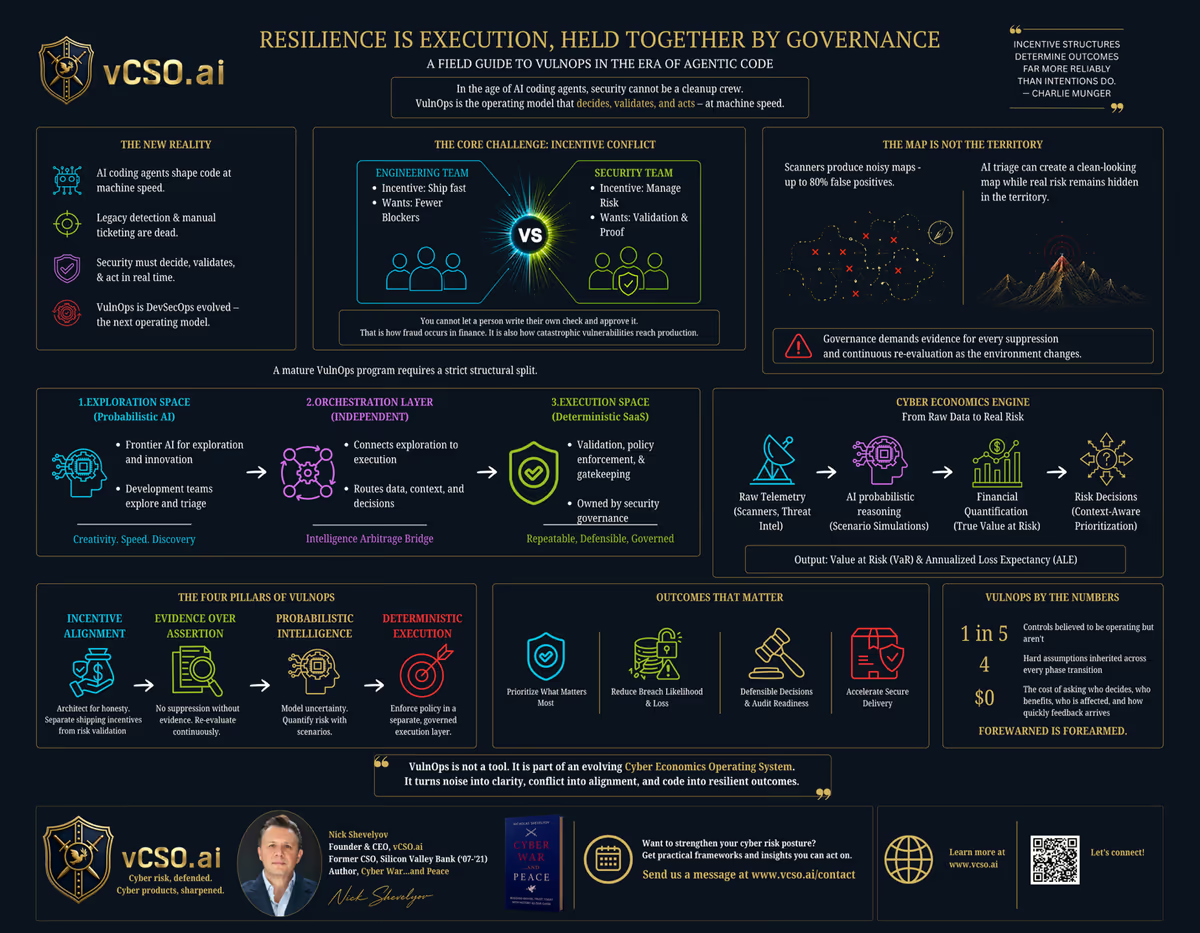
Engineering team — incentive: ship fast · wants: fewer blockers
Security team — incentive: manage risk · wants: validation and proof
→ the core VulnOps tension
This is why a mature VulnOps program requires a strict structural split — what we call the Exploration vs. Execution Stack:
Best-Effort AI (Exploration). Development teams should absolutely leverage frontier AI models to explore, innovate, and find efficiencies. This happens in the unconstrained Exploration Space. For developers, best effort is the right standard: if a skill clears roughly 80% of the workload, that is a real productivity win.
Verified Control (Execution). The validation of risk, enforcement of policy, and final gatekeeping must live in a separate, immutable Execution Space owned by security governance. Here, best effort fails: security has to answer for the missed finding, so the bar is three nines, not 80%.
By bridging these two domains through an independent Orchestration Layer, an organization achieves what can be called Intelligence Arbitrage — buying creative AI intelligence cheaply on the development side, while executing repeatable, defensible control validation on the security side.
The Map Is Not the Territory
Another mental model worth pinning to the wall: the map is not the territory. A vulnerability scanner is a map; the actual enterprise risk is the territory. When a legacy scanner flags ten thousand “criticals” and up to 80% of them are contextual false positives, you are looking at a map with badly drawn coastlines.
This is where the AI honeymoon does its real damage. A developer running an LLM triage agent against a noisy scanner can produce a highly confident, clean-looking map. The pull request flows through seamlessly. Yet, somewhere in the actual territory, a critical vulnerability sits quietly exposed because an agent labeled it a false positive based on superficial evidence.
Raw telemetry (scanners, threat intel) → AI probabilistic reasoning (scenario simulations) → financial quantification (true Value at Risk)
To fix the map, a Cyber Economics Engine must ingest continuous data and telemetry, filtering it through AI Probabilistic Reasoning (running scenario generations and Bayesian updates) to calculate the real Value at Risk (VaR) and Annualized Loss Expectancy (ALE).
Sound governance demands that the evidence for suppressing an alert be validated by the system of record accountable for protecting the business — not the system optimized to ship the code.
A Short Story About Authority
Let me anchor this in something concrete. Some time ago, I helped an organization audit a security failure. Their phishing solution had worked exactly as designed: it caught a malicious credential-harvesting email and routed it to quarantine.
Then a well-meaning, technically capable technologist reviewed the quarantine log, made an isolated judgment call, and released the email. An executive opened it. Hilarity — of the costliest variety — ensued.
During the post-mortem, the engineering team focused heavily on technical performance: Did the machine learning model classify the email correctly? But that was entirely the wrong question.
The right questions were governance questions:
- Who had the authority and accountability to override the system?
- What economic risk model justified that exception?
- Which governance entity authorized that specific policy bypass?
The technical control had performed flawlessly; the governance framework had failed completely. In the era of autonomous agents, these failures will increasingly look like technical events when they are structural governance failures.
Translate this into VulnOps and the shape is identical. A developer builds or adopts a skill that triages scanner findings. The skill labels a genuine vulnerability a false positive; the developer accepts the verdict; the finding drops off the risk register — silently, with no accountable authority ever signing off on the exception. The control worked. The governance did not.
The Pit Crew Approach to Cyber Economics
I am partial to a Formula One analogy here. A racing car cannot take corners at blistering speeds unless its brakes work flawlessly. To go fast, you must possess the absolute certainty that you can stop.
Developer velocity (the engine) → sound governance (the brakes) → maximum enterprise speed at lower VaR
VulnOps, executed through an economic framework, is the ultimate pit crew. It is not a tax on developer velocity; it is a prerequisite for it. The goal is to give engineering teams a deterministic brake they can trust implicitly, allowing them to accelerate into the turn. Organizations that internalize this will consistently out-ship their competitors because they won’t carry the crippling, unbudgeted technical debt of remediation cycles in production.
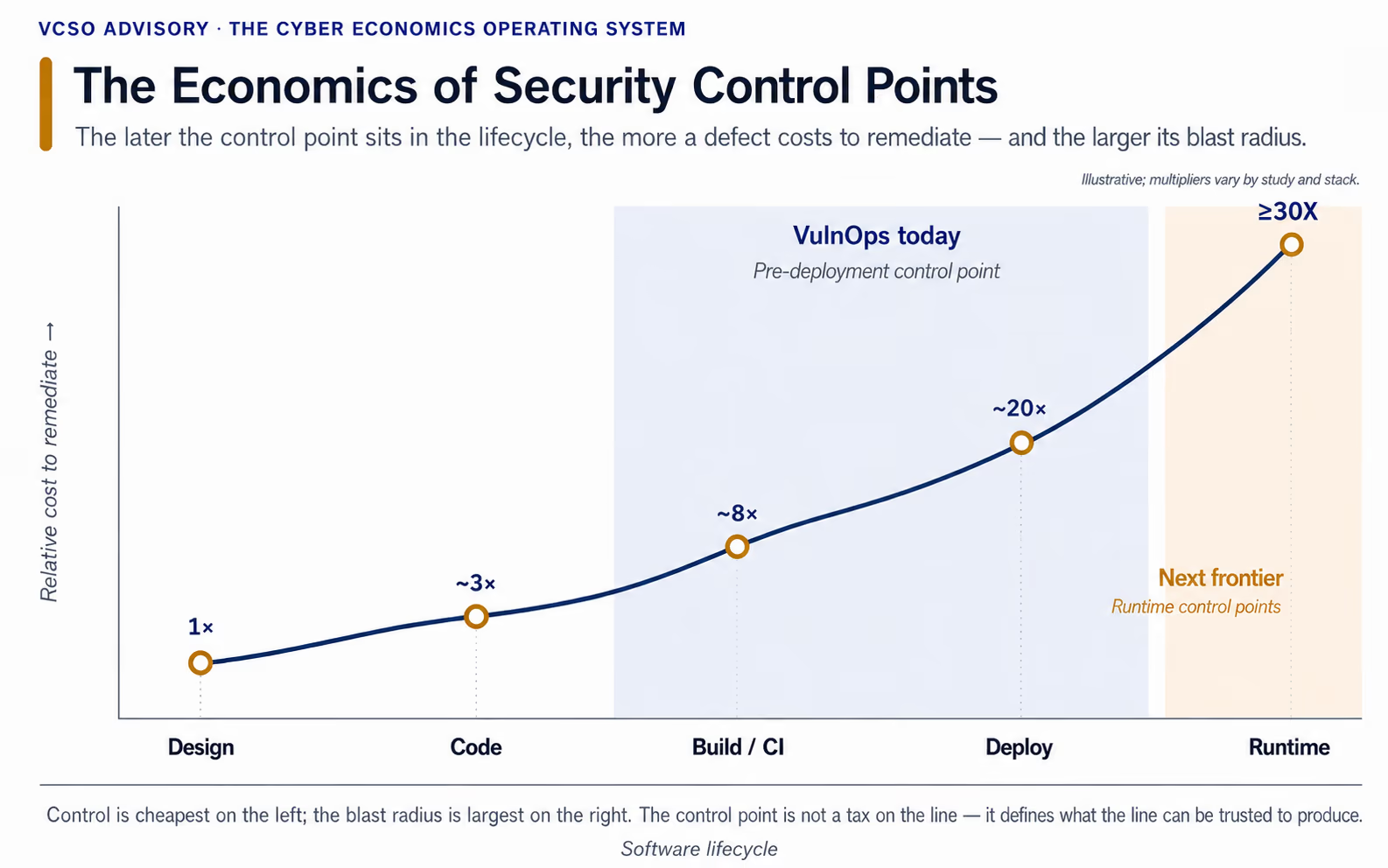
Make the analogy literal. The Exploration Space is the engine — raw, probabilistic horsepower. The Verified Control of the Execution Space is the brake, and the independent Orchestration Layer is the pit crew that tunes the handoff between them. There is also an economic law hiding in the metaphor: in any system, throughput is governed by its constraint. A validating control point is not a tax on the pipeline — it is the pipeline’s true output. Code shipped at machine speed without it is not throughput; it is unvalidated inventory moved onto the balance sheet as a liability. The constraint does not slow the line. It defines what the line can be trusted to produce.
The Blueprint for Modern VulnOps
If you are architecting a VulnOps framework built for the artificial intelligence era, it should be designed around these core operational pillars:
1. Separate the writer from the validator. The companies writing or generating the code cannot be the ones validating its security. This is the same check-and-balance principle that prevents a corporate accountant from auditing their own books. When a platform provider promises an “end-to-end autonomous AI loop” that handles both creation and defense, the answer from a governance perspective must be a firm: Thank you, but no.
2. Move from systems of detection to systems of decision. Legacy security tools tell you what is wrong; modern VulnOps platforms must declare what was decided and retain the receipts. Every single suppression, fix, or policy deferral must produce a verifiable audit trail. The board, the regulators, and the stakeholders will not accept an AI’s black-box assertion; they will demand the definitive economic and technical context behind the choice.
3. Underwrite irreducible risk. No operational control catches everything. Once your VulnOps engine has optimized your spend and reduced what is reducible through automated execution, a baseline of residual risk remains. This is where cybersecurity meets corporate finance. By translating technical vulnerabilities into explicit financial exposure (Loss Exceedance Curves), leadership can accurately align risk with the corporate appetite and underwrite the remainder through targeted cyber insurance.
4. Institute the pre-mortem habit. Before any autonomous orchestration layer is fully deployed, gather your stakeholders and ask a simple question: “Assume it is 12 months from now and this program has failed catastrophically. What caught us off guard?” Informing your roadmap with these structural blind spots is the cheapest risk mitigation strategy available to an executive.
What’s the Reality
The fundamental patterns of conflict, deception, and human error have not changed for thousands of years; only the medium’s velocity has. Cyber risk management remains a human-nature problem manifesting through highly advanced technology. Humans are the hardware, culture is the software, and culture will eat strategy for breakfast every single time.
VulnOps is simply a contemporary term for an old architecture. It is the application of segregation of duties, independent validation, and fiscal accountability to a software pipeline operating at machine speed. The tools will inevitably become more capable, and the agents more autonomous. None of that erases the immutable requirement for an independent entity whose job is to validate the work of the entity whose job is to ship.
When reality strikes and we ask, “Who is legally and financially accountable when this automated system fails?” the answer cannot be the machine, nor can it be the developer who approved their own code.
“A computer can never be held accountable,” IBM observed on a slide back in 1979, “therefore a computer must never make a management decision.”
And accountability is about to stop being rhetorical. The market is still pushing the other way — use agents, push code faster — so the forcing function will not come from the market. It will come from liability. The constraint becomes the pipeline’s accepted output only once a board can be held to answer for skipping it.
That forcing function is closer than it looks. Under the Caremark line of cases, directors already carry a duty to implement and monitor an oversight system for mission-critical risks — and a sustained failure to do so is a breach of the duty of loyalty. The EU Cyber Resilience Act sharpens the clock: vulnerability-reporting obligations bind manufacturers placing products on the EU market from September 11, 2026, with full conformity required by December 11, 2027, and penalties reaching €15 million or 2.5% of global turnover. Waiting for case law is itself an unreasonable act. The standard of care is being written now, in statute; the only open question is which board hands the plaintiff’s bar its example.
The enterprises that dominate this decade will treat VulnOps as a governance discipline first and a tooling decision second. By aligning their technical execution with a comprehensive Cyber Economics Operating System, they will ship faster, protect what matters most, and turn digital trust into an unassailable competitive advantage.
One frontier deserves naming, because it is where this goes next. VulnOps, as drawn here, lives in the pipeline — control exerted before code ships. But agents increasingly ingest and execute code at runtime, in production, from sources no one has fully vetted, carrying the agent’s own credentials and reach. The control point then shifts from the build to the live system, and the discipline starts to resemble security chaos engineering: continuously probing production to find and isolate what slipped through. That is the next control point — and the next piece in this series. The economics are unchanged; only the location of the constraint moves.