Product & GTM Advisory
Build for your buyer.
Make the value clear.
Monthly advisory with Nick Shevelyov for cybersecurity product companies: positioning, product security architecture and feedback from senior security leaders.


Who this is for
-
Founders & CEOs
Set the product direction and sharpen the case for why customers should buy.
-
Product & engineering
Connect architecture, trust and roadmap choices to enterprise adoption.
-
GTM & revenue leaders
Refine positioning, pitch and the proof security buyers need.
-
Portfolio investors
Bring buyer-side product and GTM judgment to a portfolio company.


For cybersecurity product companies. Founders lead the mandate; product, engineering and GTM owners join the relevant work. Investors can sponsor a portfolio-company engagement.
What you receive
Working materials and recommendations, developed with your team.
Positioning & pitch
One coherent product story for the buyers you want to reach.
- Clarify the ideal customer profile and differentiation.
- Compare the team’s pitches and reconcile the message.
- Refine the pitch deck and supporting proof.
Your priorities determine which working materials need attention first.
How we use it
Compare the team’s one-minute pitches, reconcile the message and refine the supporting deck. Positioning work can include customer profile, differentiation and packaging priorities.
A product story your team can carry into the next buyer conversation.

Pitch & positioning
1-Minute PitchWho you serve and the problem worth solving.
Why your approach matters alongside the alternatives.
The evidence behind the story and the next conversation.
CISO objections
Understand buyer hesitation and the evidence needed to move forward.
- Review budget, integration, trust and competing priorities.
- Map objections to supportable answers and proof.
- Record the next questions for a buyer conversation.
Your priorities determine which working materials need attention first.
How we use it
Work through architecture, governance, deployment and relevant AI questions. Record the objection, underlying concern, response, proof and status, then use buyer conversations to refine the map.
A working objection library that improves with each buyer conversation.
Buyer conversation playbook
CISO Objection MapIdentify what the security buyer is really worried about.
Connect a supportable answer to the evidence behind it.
Record what has been tested and what needs more work.
Enterprise readiness
Connect product and roadmap choices to enterprise adoption.
- Review architecture, threat models and trust materials.
- Work through deployment and readiness questions.
- Capture product gaps, needed proof and recommendations.
Your priorities determine which working materials need attention first.
How we use it
Review your own product and environment using the materials and access agreed in scope. Connect security architecture, deployment choices and buyer expectations to practical product recommendations.
A clearer view of the product work and proof needed for enterprise adoption.
Product & architecture review
Enterprise ReadinessReview the product, threat model and supporting trust material.
Work through the questions an enterprise buyer will ask.
Capture missing proof and product or roadmap recommendations.
Decisions & actions
Written recommendations and next steps that connect each working session.
- Refine the working decks with your team.
- Record decisions, evidence and unresolved questions.
- Carry follow-up work into the next agenda.
Your priorities determine which working materials need attention first.
How we use it
Use written notes and working decks to connect the sessions. Track recommendations, decisions, unresolved questions and next actions as your priorities evolve.
Continuity between reviews, with written next steps for your team.
Session notes & working decks
Decisions & Next StepsCapture the recommendation and what supports it.
Carry agreed follow-up work to the people who own it.
Bring open questions and updated material into the next review.
Ongoing Product & GTM
How monthly advisory works
Start by agreeing the product priorities, participants and working sequence. Then repeat a practical cycle of preparation, buyer-side feedback and written next steps.
- Executive review
- Once a month
- Working session
- Every other week
- Email between sessions
- Replies within one business day
Prepare the priorities
Bring your latest pitch, buyer feedback and product evidence. Agree the questions and prework for the session.
Take the buyer’s seat
Rehearse the pitch and challenge objections, proof, architecture and enterprise-readiness choices with Nick.
Test and refine
Where agreed, gather feedback from senior security leaders. Refine the story and identify the proof still needed.
Decide and follow through
Record recommendations, decisions and owners. Carry the next actions into the following review.
What to bring to the sessions
- Product and evidence
Demos, architecture, trust materials and relevant metrics.
- Buyer context
Your pitch, customer profile, pipeline visibility and buyer feedback.
- People and prework
Time with executive, product, engineering and sales owners; completed playbook prompts.
View a monthly advisory review
Illustrative outline · not a client report
- Buyer signal: Which objections changed, and what evidence supports the response?
- Working material: Compare the revised pitch, proof and enterprise-readiness priorities.
- Decisions: Record what the team will change, defer or test next.
- Follow-through: Confirm owners, prework and the next review agenda.
Six-month minimum engagement. Board support is scoped in the SOW. Implementation is done by your team or scoped separately. VTC projects are scoped separately.
Value to Customer Calculator (VTC)
Build the buyer’s business case.
Our value-to-customer methodology helps your buyers estimate savings, ROI and payback through custom calculators using their own inputs.
Discuss a VTC projectScoped separately within Product Advisory.
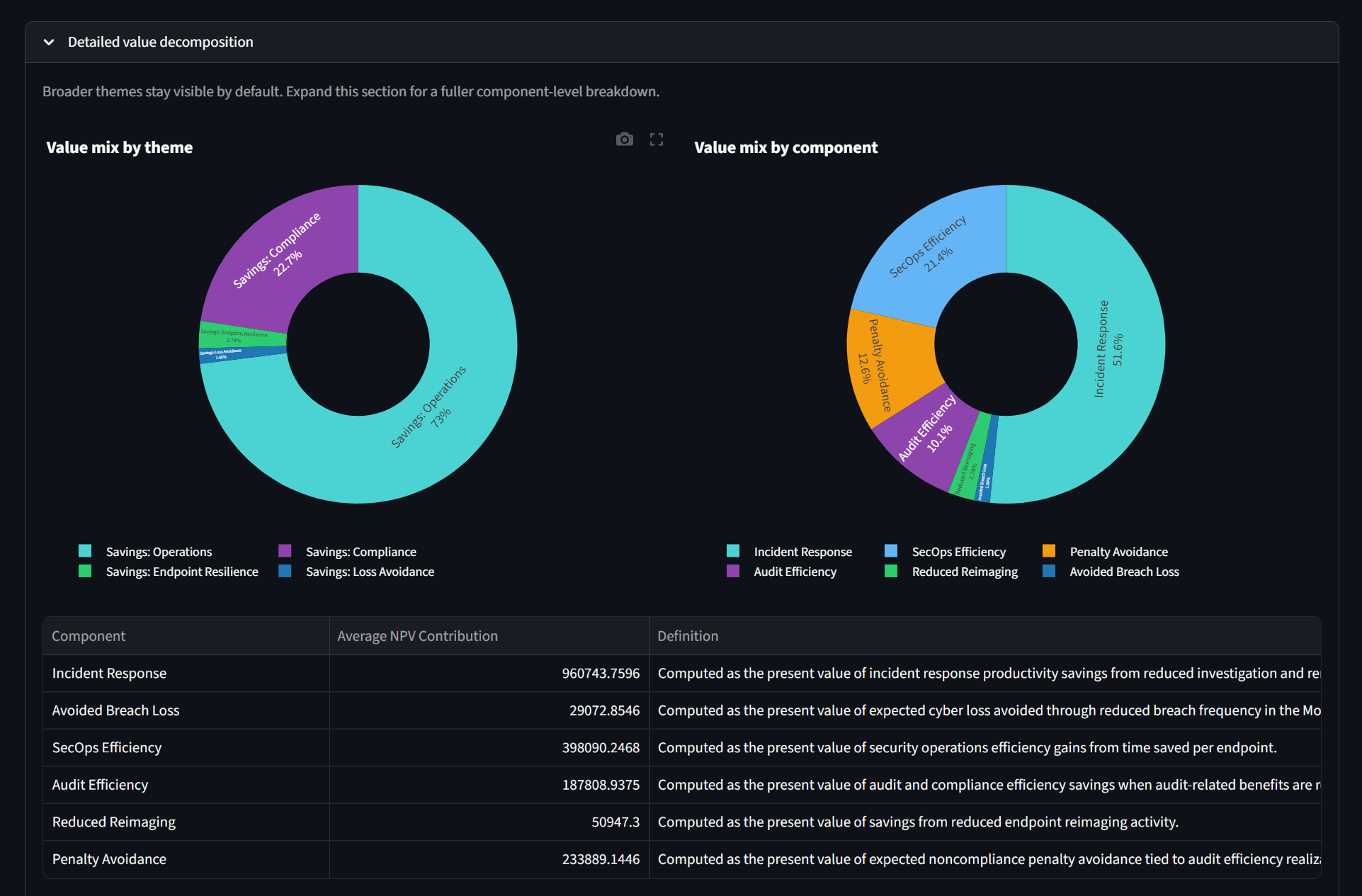
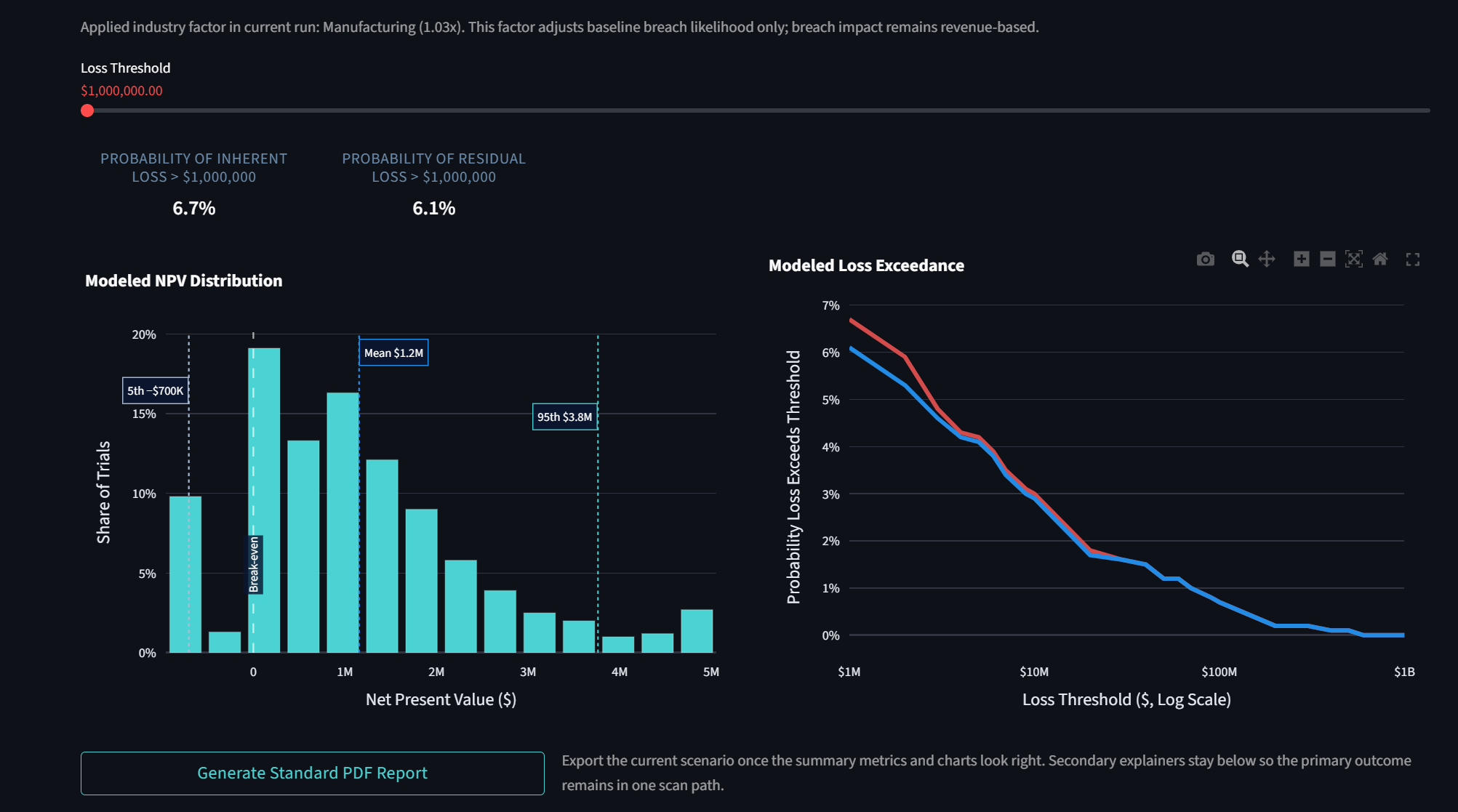
Actual calculator screens with example inputs. Modeled estimates, not customer results.
A value model
Costs, benefits and assumptions tailored to your product.
A reusable calculator
Let buyers explore their own savings and ROI.
A customer-ready report
A business case to share with finance and procurement.
How we build it with you
Define the case
Agree the customer problem, costs and benefits.
Agree the inputs
Review data, supported estimates and assumptions.
Review the model
Challenge the logic in an inspectable value model.
Build the tool
Create the scoped calculator and customer report.
Review and enable
Resolve questions and agree training, support or refinements.
A value model can become a reusable calculator and customer-ready report, with deployment and enablement support.
Use the calculator on a pricing page or in a guided sales conversation, then share the supporting report for an internal buying decision. Keep the inputs and assumptions visible so buyers can inspect the business case.
VTC is a scoped capability. Model assumptions and inputs must be supportable; the advisory program does not automatically include a calculator, hosting, updates or a guaranteed return on investment.


Your lead advisor · Nick Shevelyov
Your advisory team, led by Nick.
Nick Shevelyov founded vCSO.ai to help leaders gather the evidence, apply the judgment and build the influence to make better-informed cyber risk decisions and stay resilient. He is the former Chief Security Officer of Silicon Valley Bank and the author of Cyber War…and Peace.
Specialist supportTechnical and modeling specialists join where needed and agreed.
Meet NickOur private community forum brings cybersecurity leaders, founders and investors together.
Explore the Supper ClubQuestions about working together.
Inclusions, collaboration and responsibilities.
What’s included?
Nick-led working sessions on your product, positioning, pitch, buyer objections and enterprise readiness, with written recommendations and next steps. One monthly executive review plus a working session every other week. Email access between sessions, with replies within one business day. Six-month minimum engagement. Board support is scoped in the SOW. Implementation is done by your team or scoped separately.
Will I work directly with Nick?
Yes. Nick leads the advisory and buyer-side review. Technical or modeling specialists join for agreed work, alongside the relevant executive, product, engineering or GTM owners from your team.
What happens between sessions?
Your team shares current materials and completes the agreed prework. We carry prior notes, decisions and actions into the next agenda. Email access is included between sessions, with replies within one business day.
Does advisory include implementation?
We review your product and architecture and recommend priorities using the agreed materials and access. Your team owns decisions and execution. Engineering, tooling operation, testing, certification, standing sales execution, volume content and formal market studies require separate scope.
Can you help with buyer feedback and introductions?
Where agreed, Nick convenes senior security leaders to test your narrative and proof. We can help define a design-partner profile and make selective introductions where the fit is credible. Introduction volume, endorsement and sales outcomes aren’t guaranteed.
Is VTC included?
It isn’t automatically included. VTC can be scoped as a value model, reusable calculator, customer-ready report and agreed deployment or enablement support when a customer business case is a priority.

Make your next buyer conversation count.
Tell us about your product, next milestone and where buyers get stuck.
Discuss your productA 30-minute conversation about your priorities and whether we’re the right fit.